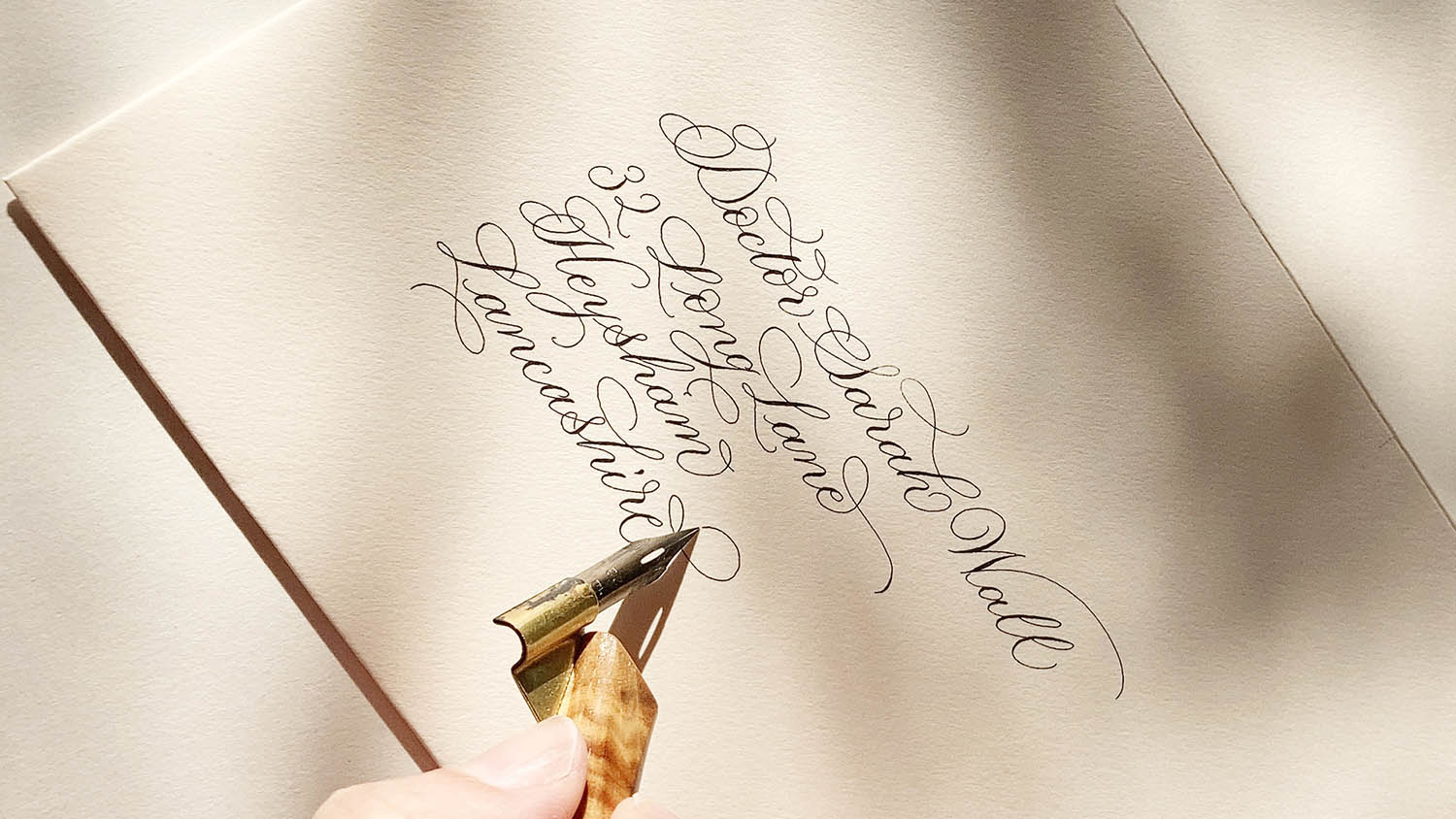
If you don’t want your wedding envelopes to read like an episode of The Handmaid’s Tale, this is YOUR guide to modern invitation and envelope etiquette.
It’s from a UK calligrapher with more than 20 years’ experience of addressing envelopes for all kinds of weddings, so consider this an official guide you can show to any older relatives insisting your envelopes are ‘done properly‘.
Let’s start with wedding etiquette, because in 2026 all of the wedding traditions are optional.
That gives us important context. Fathers only ‘give away’ their daughters if that feels comfortable. If it feels too much like a nineteenth century transaction, or if you’re both grooms or both brides (or identify with neither of those terms), no one has to give anyone away.
The same goes for a lot of pre-19th century wedding traditions: tossing the bouquet to single ladies, wearing a garter, who makes the speeches (men!), avoiding each other the night before the wedding. They’re no longer relevant, and they don’t count as rules any more. They’re just choices: things you can do if they’re fun.
The same applies to wedding invitation and envelope etiquette. I’ve been making a case for friendlier, open-minded wedding invitations and envelopes since I began addressing them for couples in 2006.
Because honestly, the wedding industry needs a shake-up. ChatGPT thinks calligraphers should be helping couples address envelopes properly – without considering the age we’re living in, or that perhaps invitation etiquette is one of the many wedding traditions which are desperately due for a change.
Keep reading, because there are some really important things you can’t afford to get wrong – I’ll run through the conventional stuff first.

Wedding envelope etiquette: the old way
I almost didn’t write this guide, until Reddit stood loud and proud at the top of my search screen with “honestly screw the traditional way“. And then I realised no one actually wants to address their envelopes to “Mr and Mrs William Shatner” as if all the women were hiding behind their husbands (first William that came to mind, sorry).
(Having said that, as I write this (13th May 2026) Brides magazine are still recommending “Mr. & Mrs. Thomas Warren”) – and if my WordPress would let me do emojis, there’d be a face-palm right here. I grabbed a screenshot from Brides’ website:
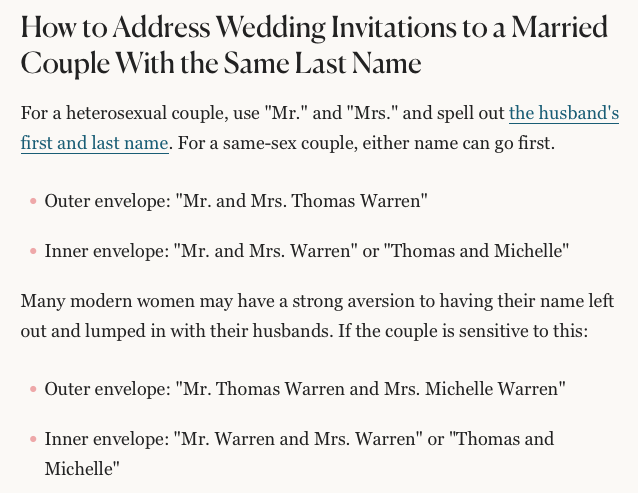
But before Reddit existed, the rules for wedding invitation envelope etiquette were:
- Titles for everyone on outer envelopes: Miss, Ms, Monsieur and so on.
- Children on inner envelopes only
- Married couples on one line (because calligraphers love that!)
- Everything: envelope, invitation – written by hand
So at this point, I’m guessing you’re with me and choosing a more modern approach to etiquette.

Modern wedding envelope etiquette: a common sense approach
Planning a wedding can be stressful enough without worrying if you need to put a dot after Mrs. on your envelopes, or whose names should go first. (Check back on that Reddit I mentioned for a fiercely feminine solution to that particular problem!)
The instincts I’ve learned over my 20 years as a wedding envelope calligrapher could serve you well if you’re struggling with a balanced way to address modern envelopes:
Remember you’re a lovely human person and not some kind of weird envelope robot. It can be sweet to be a little more formal than usual for your wedding invitations, but don’t overdo it if it feels awkward.
An easy envelope addressing checklist for sending wedding invitations
To non binary people
Use Mx only if you know this is someone’s choice.
Mx Casey Lewis
Informal: Casey Lewis
To a single man
Use ‘Mr’ for more formal addressing:
Mr Sam Carter or Mr Carter
Informal: Sam Carter
To a married couple
You can use both first names for a relaxed feel, or include titles for a more formal style.
Informal: Frank and Sam Turner or Mr Frank & Mr Sam Turner
More formal: Mr and Mr Turner or Mr & Mr Frank Turner
To a single woman
‘Ms’ is the most commonly used title today, whatever someone’s marital status.
‘Miss’ is often used for younger unmarried women, but modern etiquette is very flexible.
Informal: Jennie Buckley
More formal: Ms Jennie Buckley or Miss Buckley
To a couple who aren’t married
Informal: Ella and Katie
More formal: Ms Ella Brooks and Ms Katie Cole
Usually, the person you know best is listed first.
To a guest with a plus one
Address the envelope to the person you know, and add ‘and guest’ inside the invitation if needed.
Informal: Chloe Bennett
More formal: Miss Chloe Bennett or Miss Bennett
To a married couple with different surnames
List the name of the person you are closest to first.
Informal: Hannah Moore and Dannie Reed or Mrs Reed & Mrs Moore
More formal: Mrs Hannah Moore and Mrs Dannie Reed
To a household with children
You can use the family surname for a modern look, or include everyone’s names for a traditional style.
Informal: The Parkers
More formal: Mr and Mrs James Parker, Sophie, Henry and Lucy
To someone with a professional title
Professional titles can be used in both formal and informal addressing styles.
Informal: Dr Lewis
More formal: Doctor Amelia Lewis
To a married couple where one or both people have a title
Informal: Dr Megan and Mr Oliver Hayes
More formal: Professor Michael Green and Dr Sarah Green

Some general guidelines for addressing envelopes intuitively
- Are titles necessary? If you want to include titles do, but check them first: never assume a Mrs or a Ms, a Mx or a Dr – it’s kind of rude to get it wrong. Send a quick text and ask, or get your Mum to check!
- Who goes first? Whoever you’re closest to, or however you say it. My auntie and uncle are Janice and Martin. Never Martin and Janice – it’s just not how we refer to them. (Don’t search online to see if etiquette says the man / woman should go first. That would be weird even if it was a rule!)
- What about guests? Don’t include guests on outer envelopes: if you’re inviting plus ones, make it clear on the invitation itself, or on an inner envelope if you’re having those
- Do we need inner envelopes? By the way, inner envelopes are more of a tradition in the US than they are here. They’re luxurious and lovely, but they’ll push your stamp price up to the large letter band for sure – and most couples don’t really need them.
- ‘and’ or ampersand (&)? Purely a matter of preference. As a calligrapher, I love one of these —> & every time!
A modern calligrapher’s golden rule: Consider each invitation separately, and if in doubt, write addresses in a relaxed and informal way for friends.
You can be more formal with titles for those older relatives who are more traditional, and include all the bells and whistles of etiquette to make envelopes extra special for people who’ll appreciate it (not to stereotype anyone, but I’m thinking grandmas).
Invitation etiquette for modern wedding couples:
Wedding invitation etiquette is another hotbed of confusion sprinkled with thousands of online advice articles. I wrote an article about wedding invitation wordings for the English Wedding blog, which has 26 examples for various situations and wedding styles!
The most important advice I can share is to send wedding invitations you feel comfortable with: a formal or relaxed wording to suit your wedding style and your personalities.
If it feels weird to ask your besties for “the honour of their presence” on your wedding invitations, don’t do it. There are infinite ways to pop that particular question without feeling like you’re inviting royalty over for tea. ~ English Wedding
The real life mistakes couples make with wedding envelopes and invitations:
Some things are more important than etiquette for wedding envelopes. Never forget the purpose of your wedding invitations: to let your favourite people know the date, place and time of your wedding, so they’ll join you on the day. If your invitations never arrive, it doesn’t matter how meticulously worded they are! Here are some mistakes that are wildly easy to make!
- Missing postcodes (because they won’t get there without them. And you really, really want them to get there.)
- Wax seals / sticky-out bits (get eaten by Royal Mail’s sorting machines, which have teeth)
- The wrong stamps: thicker than half a centimetre means you need a large letter stamp. Check, and don’t chance it!
- Typos – usually the obvious: your names, the date.
- Cheap envelopes around lovely invitations (it’s why I provide a calligraphy service for beautiful wedding envelopes!)